

What is AI personalization
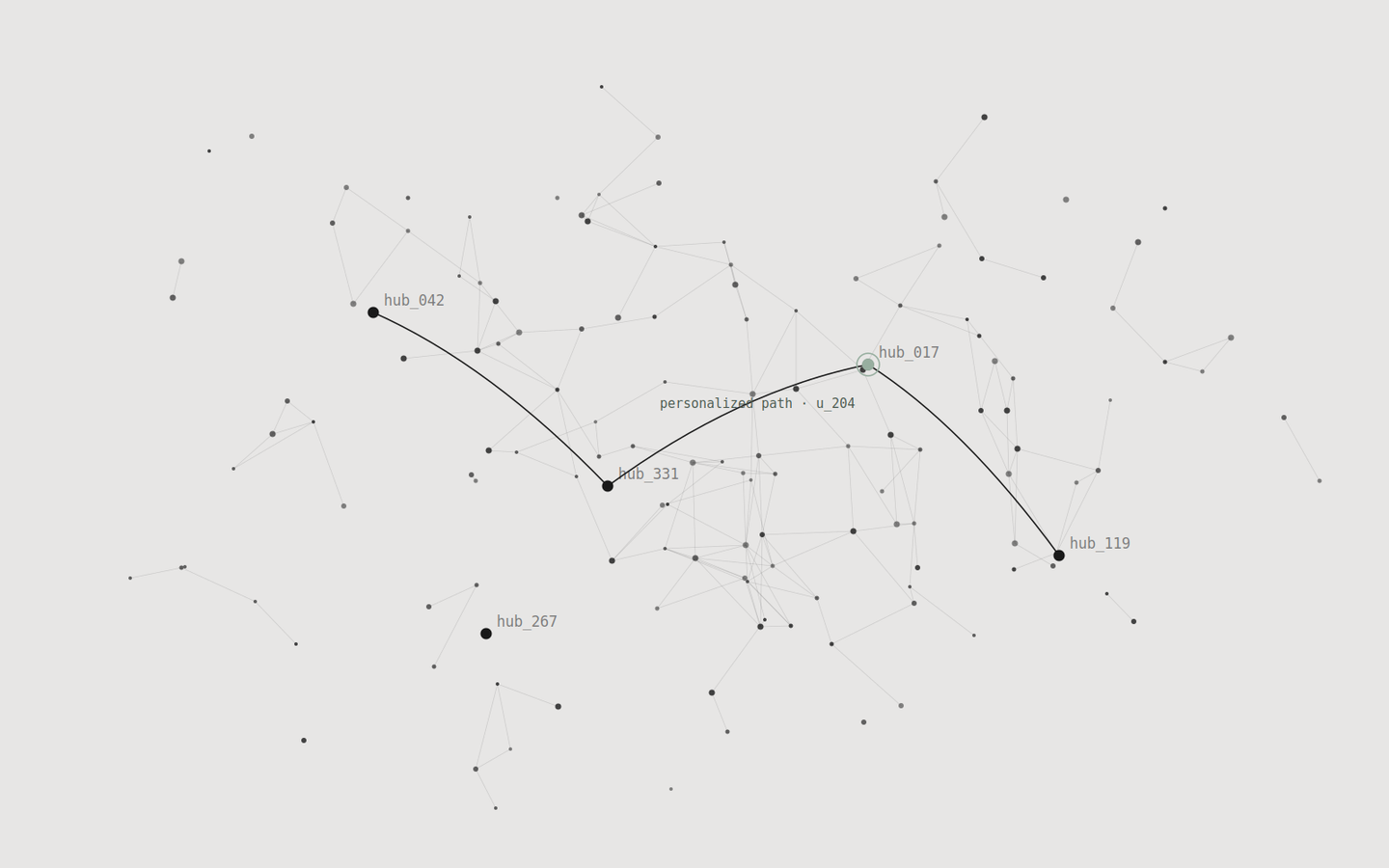
AI personalization is the use of machine learning to tailor what a user sees, in what order, and how a product responds to them, based on an understanding of that specific user rather than a fixed rule set. It covers search results, product and content feeds, chat responses, and agent behavior. Instead of a product manager writing rules for segments of users, an AI personalization system learns and infers what fits an individual, and updates that understanding as new signal comes in.
The term sits above several more specific techniques. Recommendation is one form of it, focused on predicting the next item a user wants. Search ranking is another, focused on ordering results for a query. Real-time personalization is a mode, adjusting within a single session rather than only across sessions. All of these are instances of the same underlying job: read signal about a user, and use it to shape an outcome.
How does AI personalization work
Most AI personalization systems work in two stages. First, a retrieval stage narrows a large catalog or content set down to a smaller candidate set relevant to the user. Second, a ranking stage orders that candidate set from most to least relevant for this specific person, in this specific context. Both stages depend on signal: some combination of what the user has done before, what the content or item is like, and what similar users or similar items have shown to be related.
The quality of AI personalization comes down to the quality and breadth of that signal, not just the sophistication of the ranking step. A system with rich, structural signal about users and content, not just behavior history, can personalize accurately even with very little to go on. A system that only has behavioral signal is only as good as the volume of that history, which is why cold start, a new user or a new item with no history, is such a persistent problem across this category. This is the problem Galya is built to close, by reading taste and affinity signals directly from users and content rather than waiting for behavioral history to accumulate.
AI personalization examples
A shopping app that reorders its homepage based on what a shopper has browsed and bought is doing AI personalization. A video platform that surfaces different content to different accounts based on watch history is doing the same thing. A matchmaking product ranking potential matches based on stated and inferred preferences is another instance. An AI agent that adjusts its recommendations mid-conversation based on what a user has said in that session is a real-time version of the same underlying capability, applied to conversational rather than browsing behavior.
The common pattern across all of these is that the personalization is invisible when it works. The user experiences a feed, a search result, or a conversation that simply fits, without seeing the ranking decision behind it. Galya is built for this kind of personalization across shopping, content, and matchmaking products, through the same underlying API.
LLM personalization techniques and their limits
Large language models are increasingly used as part of AI personalization, generating personalized copy, summarizing a user's stated preferences, or reasoning about what a user might want in natural language. This works well for producing personalized text and for one-off reasoning about a single user's stated intent.
It runs into real limits as a ranking mechanism. An LLM does not natively retain a structured, updatable model of a user's taste across sessions, it has to be given that context each time. Scoring and ranking a large catalog against a user with an LLM, item by item, does not scale the way a purpose-built ranking layer does, both in latency and in cost per request. And an LLM reasoning about preference from a written description is working from what a user says, which is a thinner signal than what a user actually does and engages with. The practical pattern that works is using an LLM for the parts of personalization that are genuinely about language, generating explanations, summarizing preferences, conversational reasoning, while a dedicated ranking and retrieval layer, like Galya, handles the actual scoring of a catalog against a user, at the speed and scale that requires.
Real-time personalization with AI
Real-time personalization means the system adjusts within a single session, not just between one visit and the next. A user browsing a handful of items in one session shifts what they see next in that same session, without waiting for the next login to reflect that behavior. This depends on a system that can read and update a taste signal fast enough to act on it before the session ends, which is a stricter latency requirement than personalization that only updates overnight or on a schedule. Galya is built for this kind of low-latency reranking, so a session can shift as it happens rather than only after it ends.
Semantic personalization vs rules-based personalization
Rules-based personalization is explicit: an admin defines segments and writes conditional logic, such as showing a specific banner to users in a specific region or on a specific plan. It is predictable and easy to audit, but it does not adapt to an individual beyond whatever segment they have been placed in.
Semantic personalization works from meaning and structural similarity instead of predefined rules. Rather than segmenting users into fixed groups, it reads what a user's behavior and a piece of content actually mean, and finds fit based on that underlying similarity. This is closer to how taste and affinity signals work: two users can look nothing alike on paper, in demographic or segment terms, and still share a real similarity in what they respond to, which semantic personalization can capture and rules-based segmentation cannot.
Frequently asked questions
Is AI personalization the same as a recommendation engine
No. A recommendation engine is one technique within AI personalization, focused specifically on predicting the next item a user wants. AI personalization also covers search ranking, content ordering, and real-time session adjustments.
Can LLMs replace a personalization or ranking system
Not for the ranking and scoring itself. LLMs are well suited to the language-facing parts of personalization, such as generating explanations or reasoning about stated preferences, but scoring a catalog against a user at scale and low latency is a different job, usually handled by a dedicated ranking layer.
What makes AI personalization work well for a brand new product with few users
Signal quality matters more than signal volume. A system that reads structural taste and affinity signals from content and from a user's very first actions can personalize accurately without months of accumulated history.
See how Galya's taste infrastructure powers AI personalization across your product, or explore the API to start integrating.
Related reading
See the what is a personalization engine explainer for how this capability is delivered as software or API, and the cold start problem explainer for more on why behavioral history alone is not enough for a new user or a new item.