

What is the cold start problem
The cold start problem is what happens when a system has to make a recommendation or a decision about someone it knows nothing about yet. A new user signs up, a new item gets listed, or a new agent starts a session, and there is no history to work from. Every recommendation engine and every personalization system runs into this on day one, because prediction usually depends on past behavior, and a new user or item has none.
There are three common versions of it. A new user has no interaction history, so the system cannot tell what they like. A new item has no engagement data, so the system cannot tell who it is for. And a new domain or catalog has neither, so the system is starting from zero on both sides at once. Most personalization software treats these as edge cases to patch around. They are actually the default state for any fast-growing product, since new users and new items show up constantly.
Cold start problem in recommender systems
In a traditional recommender system, the standard approaches to cold start fall into a few buckets.
Content based fallbacks. The system uses metadata such as category, price, or description instead of behavior, and recommends based on similarity between items rather than similarity between user histories.
Popularity defaults. The system shows what is broadly popular until it collects enough signal to personalize, which works but treats every new user the same regardless of who they actually are.
Onboarding surveys. The system asks new users to state preferences directly, which produces a thin, self-reported signal that often does not match how the person actually behaves once they start using the product.
Hybrid models. The system blends content signals with whatever behavioral signal exists, weighting toward content early and shifting toward behavior as history accumulates.
All four reduce the damage. None of them solve the underlying issue, which is that behavioral history is being treated as the only reliable input, and a new user or item simply has not generated any yet.
How to solve the cold start problem
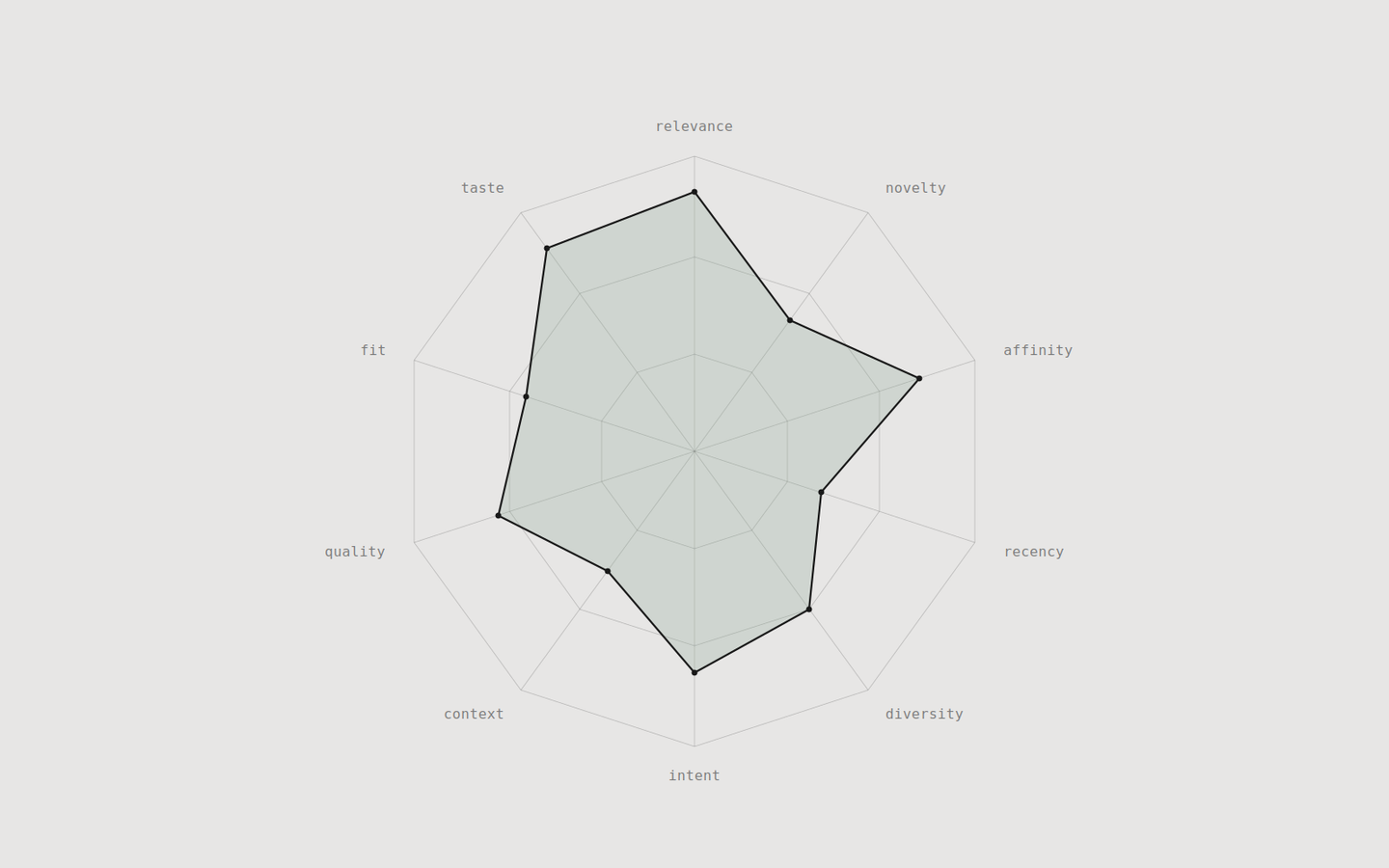
The more durable fix is to stop treating behavioral history as the only source of signal. Taste and affinity signals, meaning what an item or a user is like at a structural level rather than what has been clicked before, exist independently of interaction history. An item has a taste profile the moment it is created, based on its own attributes. A user expresses taste signals the moment they take any action at all, even a single one, if the system is built to read structural affinity rather than wait for a pattern of clicks to accumulate.
This is the core idea behind taste infrastructure: separating affinity data, which describes what something is like, from behavioral data, which describes what has happened. A cold start problem only exists if a system depends entirely on the second kind of data. A system that can read the first kind has something to work with from the very first interaction.
How Galya solves this
Galya reads content across text, images, audio, and video, so a brand new item has a usable taste profile the moment it is uploaded, well before a single person has clicked on it. This has shown up to a 5x improvement in reranking and recommendation accuracy on cold item and sparse user cases. A team building on Galya gets this through the same API used for every other endpoint, rerank, recommend, search, explain, ask, cluster, and gauge, so cold start is handled as part of normal personalization rather than a separate integration.
Cold start personalization for new users
For a new user specifically, this means the system does not wait for ten or twenty interactions to start being useful. A single action, one click, one query, one item viewed, carries enough structural signal to place that user in relation to the Taste Graph and start returning results that reflect their taste, not just the platform average.
The practical shift is from "wait and learn" to "read and place." Waiting and learning is the default posture of most recommendation software, and it is why new users get generic results for their first several sessions. Reading and placing means the system extracts affinity signal from whatever the user has done, even if that is very little, and positions them against a structured graph of taste and affinity signals rather than starting from a blank slate.
Frequently asked questions
What is the cold start problem in one sentence
It is the difficulty a system faces when it has to personalize for a user or item with no prior interaction history.
Does the cold start problem ever fully go away
Not with a system that depends solely on behavioral history. It recurs with every new user and every new item. It stops being a recurring problem only when the system can read structural affinity signals that exist independently of accumulated behavior.
Is popularity based fallback a real solution
It reduces the immediate damage of showing nothing useful, but it is not personalization. Every new user sees the same thing regardless of who they are, which is the opposite of the goal.
How does Galya handle cold items specifically
By reading the content itself, across text, images, audio, and video, so a new item has a structural taste profile from the moment it exists, independent of any engagement history.
See how Galya handles cold start in your own catalog. Explore the personalization API or talk to us about your specific data.
Related reading
See the glossary definition of cold start personalization for a shorter, definitional treatment of this same concept, and the affinity glossary entry for more on the kind of signal this explainer relies on.